Alligator Backpacks
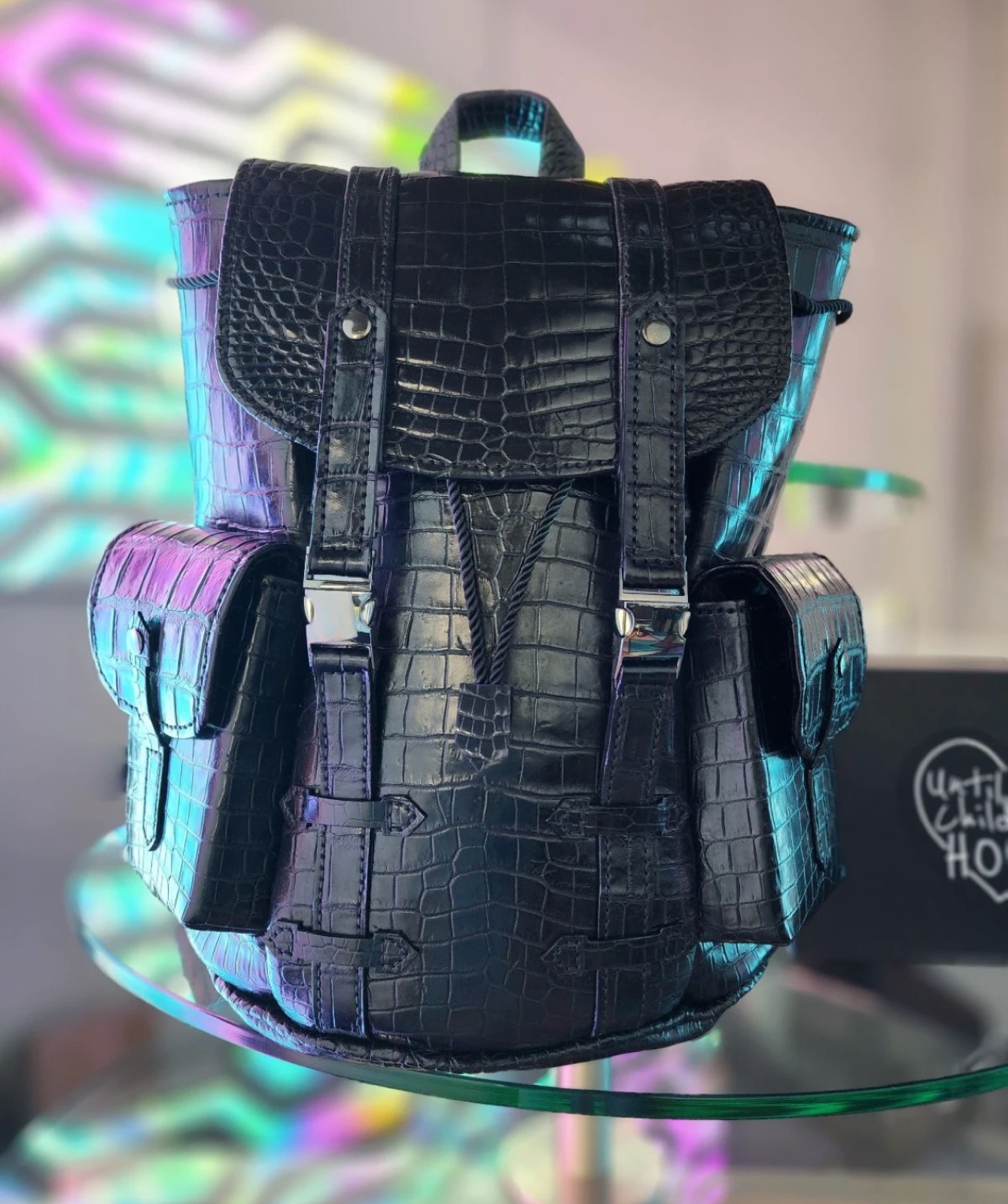
Alligator backpacks, also called gator backpacks or gator bags, are backpacks cut from genuine American alligator hide, the most valuable exotic leather produced in the United States. Frank Harkins makes his from tagged, legally sourced American alligator, cut from the belly for large, even scales and finished by hand to be carried for decades.
Read the buyer's guideThe Alligator Series
Genuine American alligator · Free tracked shipping worldwide · Secure checkout
A color of your own
Alligator takes dye deeply and evenly, so the bag can be built in a color outside the series. Tell us the color, and we confirm hide availability, lead time and price before anything is cut.
Inquire about a custom colorThe guide
An alligator backpack is cut from real alligator hide, not from cowhide stamped with a scale pattern.
Genuine alligator shows irregular scales that never repeat, a soft hand that flexes without creasing, and on belly cuts the umbilical scar, a small star-shaped patch of tight scales at the center of the hide. Embossed leather repeats its pattern every few inches and creases like card.
A backpack needs large, uninterrupted panels matched for scale size and color, which is why it takes far more hide, and far more skill, than a wallet or a belt. That matching is most of the craft and most of the cost.
What makes a genuine alligator backpack
A genuine alligator backpack is cut from the tanned hide of the American alligator, Alligator mississippiensis, not from cowhide embossed with a scale pattern. Real alligator shows irregular, non-repeating scales, a soft hand that flexes without creasing, and on belly cuts the umbilical scar, a star-shaped patch of tight scales at the center of the hide.
Every Frank Harkins backpack is cut from the belly, the center of the hide, where the scales are largest, flattest and most symmetrical. The front and the flap are matched from the same hide or from hides graded together, so the pattern reads as one piece rather than a patchwork.
Nothing on the bag is embossed, printed or bonded. The scales you see are the animal's, tanned and finished, which is why no two bags in the collection are the same and why a bag cannot be remade in the same pattern once it sells.
Alligator vs crocodile vs caiman
Alligator, crocodile and caiman are three different animals with three different leathers. Alligator has smooth scales with no pores and is the softest and most uniform. Crocodile scales each carry a tiny pore, a sensory dot, near the edge. Caiman is bony: calcium deposits leave visible creases and dimples, and the leather is stiffer, cheaper and more prone to cracking.
The names are often used loosely, and a bag sold as crocodile may be caiman. The pore test settles alligator versus crocodile; the stiffness and the creasing settle caiman. American alligator is the only one of the three farmed at scale in the United States.
| Property | American alligator | Crocodile | Caiman | Embossed cowhide |
|---|---|---|---|---|
| Scale surface | Smooth, no pores | A small pore dot on each scale | Bony, with creases and dimples | Uniform stamped pattern |
| Pattern | Irregular, never repeats; umbilical scar on belly cuts | Irregular, never repeats | Irregular and bumpy | Repeats every few inches |
| Hand | Softest and most supple | Supple | Stiff, prone to cracking | Flexible, creases like card |
| Source | Farmed in Florida and Louisiana | Africa, Australia, Southeast Asia | Central and South America | Any cattle hide |
| Price tier | Premium | Premium; saltwater crocodile is the costliest | Entry level | Low |
How to tell real alligator from embossed leather
Look for repetition first. Embossed leather is stamped with a plate, so the same scale layout repeats every few inches; real alligator never repeats. Then look for the umbilical scar on the belly, check that scale edges are soft rather than sharply pressed, and flex the leather: real alligator moves like skin, embossed cowhide creases like card.
- Repetition. Follow one distinctive scale across the panel. If you find the same shape again a hand-width away, the leather was embossed.
- The umbilical scar. Belly-cut alligator carries a small, irregular star of tight scales near the center of the hide. Plates never reproduce it convincingly.
- Scale edges. Real scales rise softly from the creases between them. Embossed scales have sharp, uniform edges pressed to one depth.
- Flex. Bend a corner. Alligator gives and springs back with no crease line. Embossed cowhide folds like card and holds the fold.
- Price and paperwork. A genuine alligator backpack costs thousands, and a legitimate maker can tell you where the hide came from. If either is missing, so is the alligator.
Belly, hornback and flank: which cut goes where
The belly is the center of the hide, with the largest, flattest and most symmetrical scales; it makes the front and the flap of a backpack. Hornback is the ridged back of the animal, used on straps, trim and statement flaps. Flank and tail scales are smaller and transitional, and go on gussets and sides where a change in scale size looks natural.
The bag is belly-cut on every visible panel. That uses the most expensive part of the hide, and it is the reason the scales on the front, the flap and the pockets line up rather than shrinking or bending as they reach the edges.
Glazed, matte or suede
Glazed alligator, sometimes sold as gloss or shiny alligator, is burnished under pressure with an agate stone until the scales shine like glass; it is the dressier finish and shows marks more readily. Matte, sometimes called millennium or safari, is left with a soft natural sheen that hides handling, ages gracefully and suits everyday carry. Suede alligator, also called alligator nubuck, is the hide finished on its flesh side and buffed to a fine nap, so it feels like velvet and shows the scale pattern only faintly. The Signature is glazed; matte is made to order, and suede bags are next in the series.
Choose glazed for a bag that is carried to dinner and kept in its dust bag between outings. Choose matte for a bag that goes to work every day, since it forgives fingerprints, rain spots and the corner of a desk. Choose suede for the softest hand and the quietest look, and keep it out of the rain; it is brushed clean rather than wiped.
What an alligator backpack costs, and why
The Frank Harkins alligator backpack is $25,000. The price is set by the hide: a full alligator backpack needs large, clean belly panels matched for scale size, which means the best grade of the largest hides. Cutting, edge finishing and stitching by hand account for the rest.
Alligator is sold by the centimetre of belly width and graded for defects, so a large, flawless hide costs several times what a small or marked one does. A wallet can be cut around a flaw. A backpack cannot, which is why it costs more than the sum of a few small goods in the same leather.
How to care for alligator leather
Wipe alligator with a dry, soft cloth after use and keep it out of prolonged sun and heat, which dry the scales. Condition it once or twice a year with a conditioner made for exotic leather, applied sparingly with the grain. Store it in its dust bag, lightly stuffed, and never soak it; if it gets wet, blot it and let it air-dry away from heat.
- Do wipe the scales with a dry microfiber cloth, following the direction of the scales.
- Do keep the bag in its dust bag, out of direct sun, when it is not being carried.
- Do use a conditioner made for reptile leather, once or twice a year, and buff it off.
- Do not use cowhide creams, saddle soap, solvents or anything containing alcohol on alligator.
- Do not leave it in a hot car, on a radiator, or in a damp cupboard; heat dries the scales, and damp lifts the finish.
- Do not overfill it. The scales are strong but the creases between them are where a strained bag shows first.
Sourcing and CITES
The American alligator is listed on CITES Appendix II, so every hide in legal trade carries a numbered tag and can be traced to a licensed farm or harvest. Alligator farming in Florida and Louisiana is regulated by state wildlife agencies and funds the management of wild populations. Domestic orders need no paperwork. International orders ship free, and the CITES export permit is obtained before the bag leaves the studio; contact us if you would like to confirm the rules for your country before ordering.
The American alligator was once endangered and is now a conservation success, with wild populations in the millions. That recovery is what makes the leather both legal and, in the view of the agencies that manage it, sustainable. We buy only tagged hide from licensed suppliers.
Gator backpacks, gator bags and alligator backpacks: the same thing
A gator backpack is an alligator backpack. Gator is the everyday American shorthand for the American alligator, so gator bags, gator backpacks and alligator backpacks all describe bags cut from the hide of Alligator mississippiensis. The words to watch for are embossed, print and effect, which mean cowhide or synthetic material stamped to look like gator.
Alligator bags come in every shape, from wallets and belts up to totes and travel bags, and the backpack is the most demanding of them because it needs the largest matched panels. The Frank Harkins bag is a genuine gator backpack: American alligator, belly-cut, tagged and traceable, and made for men and women alike.
Who makes them
The alligator backpacks are designed and sold by Frank Harkins, the contemporary artist whose original paintings are shown on this site. Each bag is finished by hand and ships anywhere in the world with free tracked shipping. Questions about a particular hide, color or size go straight to the studio through the contact page.
About Frank Harkins · Contact the studio
Last updated September 26, 2026.
Alligator backpack questions
Are alligator backpacks made from real alligator?
Yes, when they are sold as genuine alligator. Frank Harkins backpacks are cut from tagged American alligator hide, belly side out. Leather described as alligator-embossed, alligator-print or croc-effect is cowhide or synthetic material stamped with a scale pattern, and contains no alligator at all.
How much does an alligator backpack cost?
The Signature alligator backpack from Frank Harkins is $25,000. The price reflects the grade-one belly hide a full alligator backpack consumes, the matching of panels across the bag, and the hand work to cut, finish and stitch it. Tracked shipping is free worldwide.
What is the difference between alligator and crocodile leather?
Alligator scales are smooth with no pores, and the leather is the softer and more uniform of the two. Crocodile scales each carry a tiny pore, a sensory dot near the edge, which is the quickest way to tell them apart. Both are premium; caiman, often sold as crocodile, is bonier, stiffer and cheaper.
Is alligator leather durable?
Yes. Alligator is among the toughest leathers in use, and a well-made backpack outlasts cowhide by decades with basic care. The scales resist abrasion, the hide holds its shape rather than stretching, and a glazed finish that has dulled can be re-glazed by an exotic leather specialist.
Is it legal to buy and own an alligator backpack?
Yes, in the United States and in most countries. The American alligator is farmed and traded legally under CITES Appendix II, and every hide in legal trade carries a numbered tag. Some jurisdictions restrict the sale of exotic skins, so buyers outside the United States should check local rules. International orders ship free and require a CITES export permit, which is obtained before the bag leaves the studio.
How do I clean an alligator backpack?
Wipe it with a dry, soft cloth in the direction of the scales. For marks, use a barely damp cloth and dry it straight away. Condition once or twice a year with a product made for reptile leather, never cowhide cream or saddle soap, and store the bag in its dust bag away from sun and heat.
Will a glazed alligator backpack scratch?
Glazed alligator shows scratches and water spots more readily than matte, because the shine is a polished surface. Light marks usually buff out with a soft cloth; deeper ones need a specialist. Matte alligator hides daily handling and develops a patina instead, which is why we recommend it for everyday carry.
Can I order an alligator backpack in a custom color?
Yes. Alligator takes dye deeply and evenly, so the bag can be built in a color of your choosing. Contact us with the color you have in mind, and we will confirm hide availability, lead time and price before anything is cut.
What is a gator backpack?
A gator backpack is a backpack made from American alligator leather; gator is simply the common name for the alligator. Frank Harkins gator backpacks are cut from the belly of tagged American alligator hide and finished by hand. If a listing says gator-embossed or gator-print, it is cowhide or synthetic material stamped with a scale pattern.
Are gator bags real alligator?
Genuine gator bags are real American alligator. The hide is farmed in Florida and Louisiana under CITES rules, and every legally traded hide carries a numbered tag. The quickest checks are the ones on this page: no repeating scale pattern, soft scale edges, a hand that springs back when flexed, and a maker who can say where the hide came from.
Do you make alligator backpacks for men?
Yes. The Signature is a full-size alligator backpack carried by men and women alike. It is made in glazed jet black, as photographed, and can be made to order in other colors and in a matte finish; suede bags are next in the series.
Do you make suede alligator bags?
Yes, suede alligator bags are the next drop, coming soon. Suede alligator, also called alligator nubuck, is the same tagged American alligator hide finished on its flesh side and buffed to a fine nap, so it feels like velvet and shows the scale pattern only faintly. Join the list through the inquiry page to hear before they are released.